Meta Ads30 Oct 202613 min read
How to Generate Quality Leads Through Facebook Ads
Learn how to generate quality leads through Facebook Ads using effective audience targeting creative strategies lead forms conversion tracking and campaign optimization. Discover practical ways to reduce cost per lead and attract potential customers.
By Ayesh Zubair
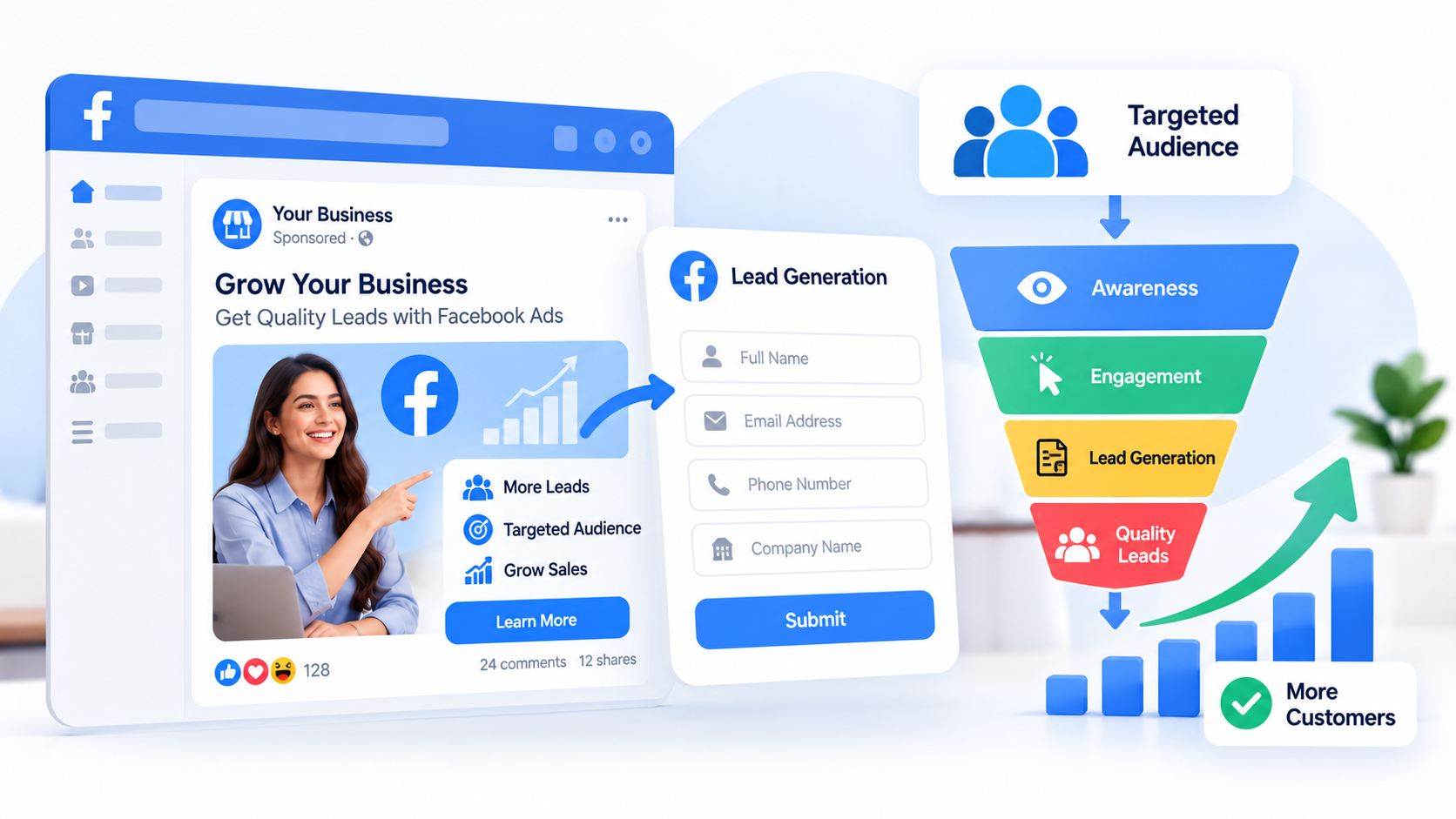
Generating leads is one of the biggest challenges for businesses that want to grow online. Whether you offer professional services, sell products, or operate a local business, finding potential customers who are genuinely interested in your offerings is essential for sustainable growth.
Facebook Ads, managed through Meta Ads Manager, provides businesses with opportunities to reach targeted audiences across Facebook, Instagram, Messenger, and other eligible placements.
However, getting hundreds of leads does not necessarily mean your advertising campaign is successful. If most enquiries come from people who are not interested in purchasing, your marketing budget may be wasted.
The real objective should be to generate quality leads who have a genuine interest in your products or services and are more likely to become paying customers.
In this guide, we explain how to generate quality leads through Facebook Ads using audience targeting, compelling creatives, optimized lead forms, conversion tracking, and campaign optimization.
1. Define Your Ideal Customer Before Running Ads
Before launching a Facebook Ads campaign, you need to understand who your ideal customers are.
Running advertisements without a clear audience strategy can result in irrelevant clicks, low-quality enquiries, and unnecessary advertising expenses.
Start by identifying the characteristics of your target customers.
Consider the following factors:
- Location: Which cities, regions, or countries do you want to target?
- Age Group: What age range is most relevant to your product or service?
- Interests: What topics, products, or activities are relevant to your audience?
- Customer Needs: What problems are your potential customers trying to solve?
- Buying Intent: Are they researching options or actively looking for a solution?
- Budget: Can your target audience afford your products or services?
For example, if you offer website development services to small businesses, your ideal audience may include business owners, entrepreneurs, and companies looking to establish or improve their online presence.
The more clearly you define your target market, the easier it becomes to develop relevant advertisements and messaging.
2. Choose the Right Facebook Lead Generation Campaign Objective
Selecting the appropriate campaign objective is an important part of your advertising strategy.
For businesses looking to generate enquiries, Meta provides lead-focused campaign options through Ads Manager.
Leads Objective
The Leads objective is designed to help businesses collect information from potential customers.
Depending on your setup, you can use different conversion locations.
Instant Forms
Instant Forms allow users to submit their contact information directly within Facebook or Instagram without visiting an external website.
They are useful for businesses that want to reduce friction and make the enquiry process easier.
Website Forms
Website forms direct potential customers to a landing page where they can learn more about your services and submit their information.
This approach gives businesses more control over the enquiry experience and allows them to provide additional information before collecting leads.
Messaging
Businesses can use messaging-based lead generation to encourage potential customers to start conversations through supported messaging platforms.
This can be useful when customers need additional information before submitting an enquiry.
Choose the conversion location based on your business model, sales process, and ability to follow up with leads.
3. Use the Right Audience Targeting Strategy
Audience targeting plays an important role in lead generation.
Even a well-designed advertisement may produce poor results if it reaches people who have little interest in your offering.
Meta provides several audience targeting approaches that businesses can use.
Core Audience Targeting
You can build audiences using available targeting options such as:
- Location
- Age
- Language
- Demographics
- Interests
- Behaviours where available
For example, a real estate company promoting residential properties may target people in specific locations and use relevant audience signals where appropriate.
However, avoid adding too many targeting restrictions without a clear reason. A very narrow audience can limit delivery and reduce campaign flexibility.
Custom Audiences
Custom Audiences allow businesses to reach people who have already interacted with their brand or business.
Depending on available data and permissions, these audiences can include:
- Website visitors
- Existing customer lists
- Facebook and Instagram engagers
- Video viewers
- Previous lead form users
These audiences can be useful for remarketing campaigns and re-engaging potential customers who have already shown interest.
Lookalike Audiences
Lookalike Audiences help advertisers find new people who share characteristics with an existing source audience.
For example, a business can use a suitable customer list or high-quality lead audience as a source to identify potentially relevant new prospects.
The quality of the source audience matters. A list of genuine customers or qualified leads is generally more useful than a list containing large numbers of irrelevant enquiries.
Advantage+ Audience
Meta also provides AI-assisted audience expansion and targeting features through Advantage+ audience options.
These features can help Meta identify potential customers beyond the initial audience suggestions.
For many campaigns, it is worth testing broader targeting alongside more controlled audience approaches rather than assuming one method will always perform better.
4. Create High-Converting Facebook Ad Creatives
Your advertisement is often the first interaction potential customers have with your business.
A strong creative should attract attention, communicate a clear benefit, and encourage the right audience to take action.
Use Clear and Relevant Visuals
Your images and videos should explain what you offer.
For example:
- A home renovation company can showcase completed projects.
- A digital marketing agency can highlight its services and genuine results.
- An eCommerce store can display its products with clear benefits.
- A training institute can showcase courses and learning opportunities.
Avoid using visuals that look attractive but have little connection to your actual offering.
Focus on Customer Problems
People are more likely to respond to advertisements that address problems they want to solve.
For example, instead of simply advertising digital marketing services, explain how your services can help businesses attract relevant traffic and generate qualified enquiries.
Test Different Creative Formats
Consider testing:
- Single-image advertisements
- Short-form videos
- Carousel advertisements
- Customer testimonials
- Product demonstrations
- Before-and-after visuals where appropriate
Different audiences respond differently to creative formats. Use actual campaign data to identify which combinations generate the best results.
5. Write Compelling Facebook Ad Copy
Your advertisement copy should clearly communicate the value of your product or service.
A good Facebook ad usually includes three important elements.
Primary Text
The primary text introduces the offer, explains its benefits, and gives users a reason to take action.
Example:
Looking for More Customers for Your Business?
Reach potential customers with professionally managed Facebook and Instagram advertising campaigns. Get a customized strategy designed to attract relevant enquiries and support your business growth.
Headline
Your headline should be short and communicate the main benefit.
Examples:
- Generate More Quality Leads
- Grow Your Business Online
- Professional Digital Marketing
- Get a Free Consultation
- Reach Your Target Customers
Call to Action
Choose a CTA that matches your campaign objective.
Examples include:
- Learn More
- Sign Up
- Get Quote
- Contact Us
- Book Now
Avoid using aggressive or misleading claims. Your advertisement should accurately represent the product or service being promoted.
6. Optimize Your Facebook Lead Forms
If you use Instant Forms, their structure can have a significant impact on lead volume and quality.
A form that asks for too little information may attract many low-intent enquiries. A form that asks for too much information may discourage genuine prospects from submitting their details.
The goal is to find the right balance.
Ask Relevant Questions
Depending on your business, consider collecting:
- Full name
- Email address
- Phone number
- Company name
- Required service
- Budget range
- Project requirements
Only request information that is genuinely useful for qualifying and following up with leads.
Use Higher-Intent Forms
Meta offers form options designed to add a review step before submission.
Higher-intent forms can encourage users to check their information before submitting it.
This additional step may help reduce accidental or low-quality submissions, although it does not guarantee that every lead will be qualified.
Add a Clear Introduction
Explain what users will receive after submitting the form.
For example:
"Complete the form to request a consultation. Our team will review your requirements and contact you to discuss the next steps."
Optimize the Thank-You Screen
After submission, tell users what happens next.
You can explain the expected follow-up process and provide an appropriate next action, such as visiting your website or contacting your team.
7. Use a Landing Page to Improve Lead Quality
Instant Forms are not the only way to generate leads.
For some businesses, sending advertising traffic to a dedicated landing page can produce better-qualified enquiries.
A landing page gives potential customers an opportunity to understand your offering before submitting their information.
An effective lead generation landing page should include:
Clear Value Proposition
Explain what your business offers and why potential customers should consider it.
Relevant Service Information
Provide details about your services, benefits, and how your solution addresses customer needs.
Trust Signals
Include genuine testimonials, reviews, case studies, certifications, or business information where relevant.
Simple Lead Form
Make it easy for interested visitors to contact your business.
Mobile Optimization
Ensure the page loads quickly and works properly on mobile devices.
Your advertisement and landing page should communicate a consistent message. If your ad promotes a particular service, the landing page should focus on that same service.
8. Set Up Conversion Tracking Properly
Accurate tracking helps you understand which campaigns and advertisements are generating meaningful business results.
Meta Pixel and Conversions API can help businesses measure website actions and send relevant event information to Meta, subject to appropriate consent and privacy requirements.
Important events may include:
- PageView
- ViewContent
- Lead
- CompleteRegistration
- Purchase
Choose events based on your actual business objectives.
For lead generation, tracking a completed lead submission is generally more useful than treating every page view or button click as a successful lead.
If you use website-based campaigns, test your tracking setup to ensure that events are recorded correctly and duplicate conversions are avoided.
For businesses using CRM systems, connecting qualified lead and customer outcomes can provide additional information about the quality of leads generated through advertising.
9. Optimize Campaigns Based on Lead Quality
One of the most common mistakes in Facebook Ads management is judging campaign performance only by cost per lead.
A low CPL may look attractive, but it does not necessarily mean the campaign is generating valuable customers.
For example:
| Metric | Campaign A | Campaign B |
|---|---|---|
| Leads Generated | 100 | 50 |
| Cost Per Lead | $5 | $10 |
| Total Ad Spend | $500 | $500 |
| Qualified Leads | 10 | 25 |
| Cost Per Qualified Lead | $50 | $20 |
Campaign A generates more leads at a lower cost per lead.
However, Campaign B produces more qualified leads and a lower cost per qualified lead.
This demonstrates why lead quality should be considered alongside lead volume.
Important Metrics to Monitor
Cost Per Lead (CPL)
The average advertising cost required to generate one lead.
Cost Per Qualified Lead
The average advertising cost required to generate a lead that meets your qualification criteria.
Lead Qualification Rate
The percentage of generated leads that meet your business requirements.
Conversion Rate
The percentage of users who complete the desired action after interacting with your advertisement.
Customer Acquisition Cost (CAC)
The total cost associated with acquiring a paying customer.
Return on Ad Spend (ROAS)
The revenue attributed to advertising divided by the advertising cost, when reliable revenue tracking is available.
Review these metrics regularly to understand which campaigns are delivering the strongest business outcomes.
10. Follow Up With Leads Quickly
Generating a lead is only the beginning of the sales process.
If your business does not respond to enquiries promptly, potential customers may lose interest or contact competitors.
Establish a clear lead follow-up process.
Consider these practices:
- Contact new leads as soon as reasonably possible.
- Use a CRM to organize enquiries.
- Assign leads to the appropriate sales representative.
- Record the source and campaign of each enquiry.
- Follow up with prospects who need additional information.
- Track which leads become paying customers.
You can also use email or messaging automation to acknowledge enquiries and explain the next steps.
However, automated messages should not replace genuine communication when a potential customer needs personal assistance.
11. Common Facebook Ads Mistakes to Avoid
Even businesses with good products and services can struggle with Facebook lead generation because of poor campaign management.
Avoid these common mistakes:
Targeting an Irrelevant Audience
If your advertisements reach people who are unlikely to need your services, lead quality may suffer.
Using Weak Ad Creatives
Generic visuals and unclear messaging may fail to attract the right customers.
Asking Too Few or Too Many Questions
A poorly designed lead form can either attract unqualified enquiries or discourage genuine prospects.
Ignoring Lead Follow-Up
Slow responses can reduce the chances of converting enquiries into customers.
Focusing Only on Cheap Leads
Low CPL does not always mean good campaign performance.
Not Testing Different Creatives
Using the same advertisement indefinitely can limit opportunities to identify better-performing messaging.
Ignoring Conversion Tracking
Without accurate measurement, it becomes difficult to understand which campaigns contribute to real business outcomes.
12. How Much Should You Spend on Facebook Ads?
Your advertising budget should depend on your industry, target market, competition, expected CPL, and business goals.
There is no fixed budget that works for every business.
For example, a business with a daily budget of $20 would have an approximate monthly advertising budget of $600 over 30 days.
Rather than dividing a limited budget across many unrelated campaigns, start with a focused campaign structure.
A practical approach is to:
- Identify your most profitable service or product.
- Select a relevant target audience.
- Create a small number of strong creative variations.
- Choose the right lead generation method.
- Track completed enquiries.
- Evaluate lead quality and cost per qualified lead.
- Scale campaigns when performance supports additional investment.
Avoid increasing budgets simply because a campaign generates a large number of inexpensive leads. Make scaling decisions based on qualified leads and actual sales performance.
Final Thoughts
Facebook Ads can be an effective lead generation channel for businesses that want to reach relevant audiences and attract potential customers.
However, successful lead generation requires more than selecting an audience and launching an advertisement.
You need a clear understanding of your ideal customers, compelling ad creatives, relevant messaging, optimized lead forms, accurate conversion tracking, and a consistent follow-up process.
Most importantly, measure the quality of the leads you generate rather than focusing only on the number of submissions or the lowest cost per lead.
A well-managed Facebook Ads strategy should help your business attract people who are genuinely interested in your products or services and have the potential to become long-term customers.
Looking to generate more qualified leads through Facebook Ads? Explore Scalviro's digital marketing services and build an advertising strategy focused on meaningful business growth.

About the author
Ayesh Zubair
Founder of Scalviro · Digital Marketer
Ayesh Zubair is the founder of Scalviro, providing SEO, Google Ads and Meta Ads management. He writes about search visibility, paid advertising and digital marketing strategies for businesses.