SEO30 Oct 202611 min read
SEO vs Google Ads: Which Is Better for Small Businesses?
SEO and Google Ads are two powerful ways for small businesses to attract customers online. Compare their costs benefits results and long-term value to discover which marketing strategy is right for your business.
By Ayesh Zubair
Growing a small business online can be challenging, especially when marketing budgets are limited and every customer matters. Business owners want to attract more visitors, generate qualified leads, and increase sales without wasting money on marketing activities that do not deliver results.
Two of the most popular digital marketing strategies for achieving these goals are Search Engine Optimization (SEO) and Google Ads.
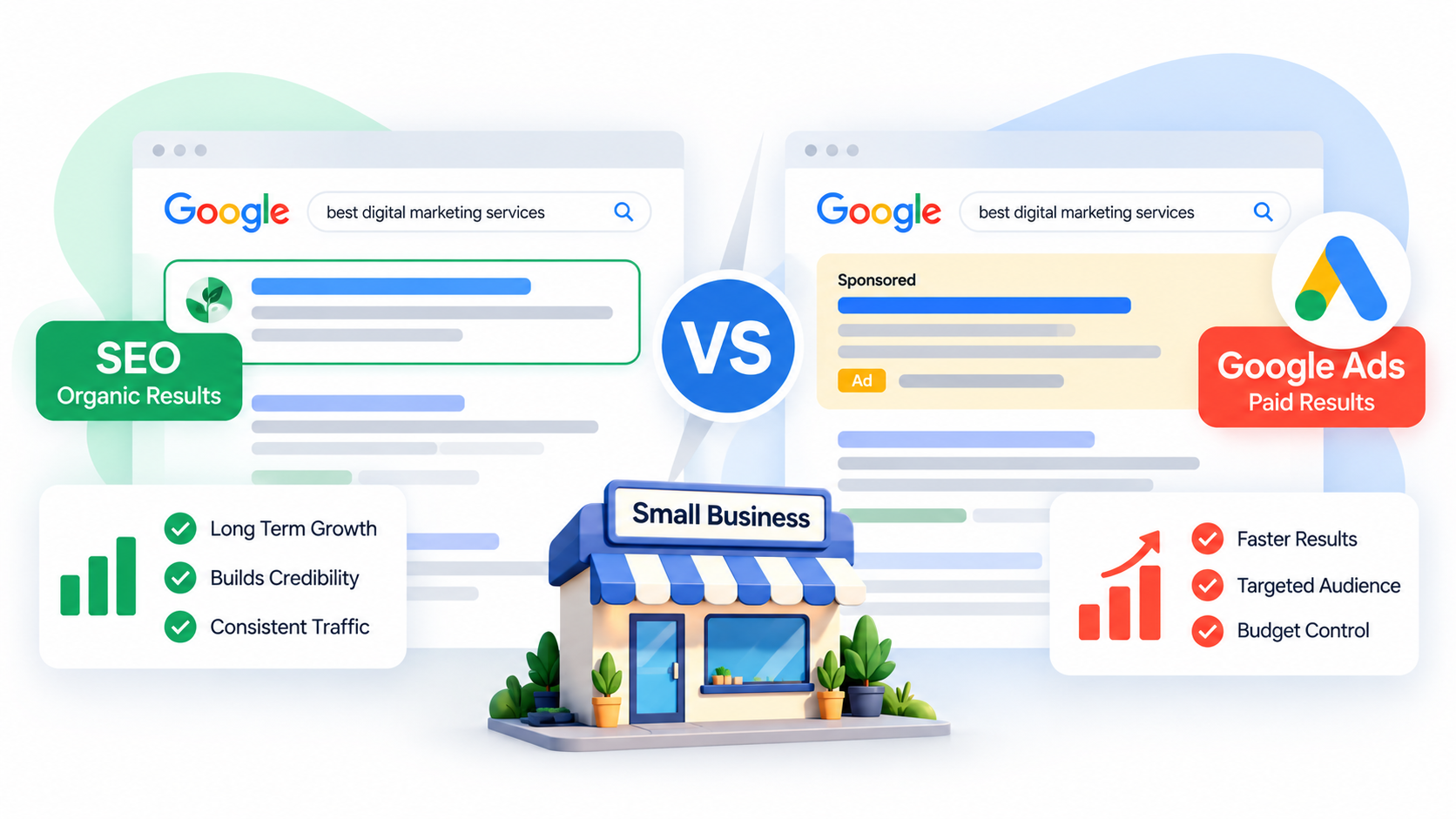
Both help businesses reach people who are actively searching for products and services. However, they work differently. SEO focuses on improving organic search visibility over time, while Google Ads allows businesses to pay for advertising placements and reach potential customers through targeted campaigns.
So, which one is better for small businesses?
The answer depends on your budget, business goals, competition, and how quickly you need results. Let's compare both strategies to help you make the right decision.
What Is SEO?
Search Engine Optimization (SEO) is the process of improving a website's visibility in organic search engine results.
When someone searches for a product or service on Google, the search engine displays relevant results based on factors such as content quality, relevance, website experience, and authority.
SEO helps your website appear in these unpaid search results when potential customers search for relevant keywords.
For example, a small plumbing business may target keywords such as:
- Emergency plumber near me
- Plumbing services in London
- Affordable plumbing company
- Local bathroom installation services
By creating relevant content, optimizing service pages, improving website performance, and building quality backlinks, the business can increase its chances of attracting organic visitors.
Benefits of SEO for Small Businesses
1. Long-Term Organic Traffic
One of the biggest advantages of SEO is its potential to generate consistent organic traffic without paying for every individual click.
Once your website earns strong search visibility, relevant pages can continue attracting visitors over time. However, maintaining those rankings requires ongoing optimization and quality content.
2. Builds Brand Credibility
Many customers trust businesses that appear prominently in organic search results.
A strong SEO presence can help establish your business as a credible source of information and a reliable service provider.
3. Lower Cost Per Visit Over Time
SEO requires investment in content, technical improvements, and optimization. However, you do not pay Google for every organic click.
As your website gains visibility, the cost per organic visit may decrease over time, although SEO is never completely free.
4. Supports Multiple Customer Journeys
SEO can attract customers at different stages of the buying process.
Informational blog posts help people understand a problem, comparison pages support purchasing decisions, and service pages attract visitors with stronger buying intent.
5. Creates Long-Term Marketing Assets
High-quality content, optimized landing pages, and relevant backlinks can continue supporting your website's visibility long after they are published.
What Is Google Ads?
Google Ads is a paid advertising platform that allows businesses to display advertisements across Google's advertising network.
With Search campaigns, businesses can show ads when users search for specific products or services. Other campaign types can reach audiences through additional Google advertising placements.
For example, a digital marketing company may target searches such as:
- Digital marketing services
- Google Ads management services
- SEO agency near me
- PPC management company
When someone searches for these terms, relevant ads may appear above or among organic search results.
Businesses generally pay based on their campaign bidding strategy and the advertising interaction or result being optimized.
Benefits of Google Ads for Small Businesses
1. Faster Visibility
Unlike SEO, which generally takes time to build organic rankings, Google Ads can start generating impressions and clicks shortly after a campaign is approved and launched.
This makes it useful for businesses that need immediate exposure.
2. Precise Audience Targeting
Google Ads provides targeting options that help businesses reach relevant audiences based on factors such as location, language, search intent, and campaign settings.
A local business can focus its advertising on customers within specific cities or service areas.
3. Budget Control
Small businesses can set campaign budgets and adjust spending based on performance.
You can start with a controlled budget, evaluate results, and increase investment when campaigns generate profitable leads or sales.
4. Measurable Performance
Google Ads provides performance data such as impressions, clicks, click-through rates, average cost per click, conversions, and conversion value when properly configured.
With accurate conversion tracking, businesses can understand which campaigns and keywords contribute to their goals.
5. Flexible Campaign Optimization
Advertisers can test different keywords, headlines, descriptions, landing pages, and bidding strategies.
This flexibility makes it possible to identify opportunities and improve campaign performance using actual data.
SEO vs Google Ads: Key Differences
Although both strategies help businesses attract customers from Google, their costs, timelines, and approaches are different.
| Factor | SEO | Google Ads |
|---|---|---|
| Traffic type | Organic | Paid |
| Initial visibility | Usually gradual | Can be faster |
| Cost model | Investment in optimization | Advertising budget and management |
| Long-term value | Can build lasting visibility | Requires ongoing ad spend |
| Budget control | Less direct control over traffic | Direct campaign budget controls |
| Targeting | Based on content and search relevance | Multiple advertising targeting options |
| Measurement | Rankings, traffic, leads, conversions | Clicks, CPC, leads, conversions, ROAS |
| Best suited for | Sustainable organic growth | Faster visibility and demand capture |
Neither strategy guarantees leads or sales. Results depend on factors such as keyword selection, competition, landing page quality, website experience, and conversion tracking.
Which Is More Affordable for Small Businesses?
Budget is often one of the most important considerations for small business owners.
However, comparing SEO and Google Ads based only on their initial costs can be misleading.
SEO Costs
SEO typically involves investment in:
- Keyword research
- Technical SEO
- On-page optimization
- Content creation
- Link building
- Website performance improvements
- Ongoing monitoring and reporting
The cost depends on the website's current condition, competition, target market, and the amount of work required.
SEO may take several months to produce meaningful results, so businesses need to consider the time required to build organic visibility.
Google Ads Costs
Google Ads requires an advertising budget as well as campaign management and optimization.
Your spending depends on factors such as:
- Industry competition
- Keyword cost per click
- Geographic targeting
- Daily campaign budget
- Conversion rates
- Bidding strategy
For example, a small business spending $20 per day on Google Ads would have an approximate monthly advertising budget of $600 over a 30-day period.
However, spending more does not automatically mean generating more customers. Campaign performance depends on the quality of traffic and how effectively visitors convert.
The better investment is the strategy that generates qualified customers at a sustainable acquisition cost.
How Long Does SEO Take Compared to Google Ads?
The timeline is another major difference.
SEO Timeline
SEO generally requires consistent work before a website can achieve strong organic visibility.
Some technical improvements may produce benefits relatively quickly, while competitive keyword rankings can take several months or longer.
Factors affecting SEO timelines include:
- Website age and authority
- Existing organic rankings
- Keyword competition
- Content quality
- Backlink profile
- Technical website issues
- Search engine updates
SEO should be treated as a long-term investment rather than a quick source of traffic.
Google Ads Timeline
Google Ads can provide visibility much faster.
Once campaigns are approved and launched, advertisements can begin receiving impressions and clicks. However, generating profitable conversions may require testing and optimization.
Businesses should allow campaigns enough time and data to evaluate performance rather than making frequent changes based on a small number of clicks.
When Should Small Businesses Choose SEO?
SEO may be the better starting point when your business wants to establish a long-term online presence.
Consider prioritizing SEO if:
- You want to build consistent organic traffic.
- Your business has a limited advertising budget.
- Customers regularly search for your services online.
- You can invest in content and website improvements.
- You want to establish authority in your industry.
- You are building a long-term digital marketing strategy.
For example, a local accounting firm can publish useful tax guides, optimize service pages, and target location-based keywords to attract potential clients through organic search.
Over time, these pages can become valuable sources of relevant traffic and enquiries.
When Should Small Businesses Choose Google Ads?
Google Ads may be the better option when your business needs faster visibility or wants to target customers with strong buying intent.
Consider prioritizing Google Ads if:
- You need leads or sales quickly.
- You are launching a new product or service.
- You want to target specific locations.
- Your business operates in a competitive market.
- You have a defined advertising budget.
- You want to test demand for a particular service.
For example, a new home renovation company can launch Search campaigns targeting people actively searching for renovation services in its service area.
Instead of waiting for organic rankings, the business can start reaching potential customers through paid search advertisements.
However, a successful campaign still requires relevant keywords, compelling ad copy, an effective landing page, and accurate conversion tracking.
Can Small Businesses Use SEO and Google Ads Together?
Yes. In many situations, combining SEO and Google Ads is more effective than relying on only one channel.
Both strategies can support different parts of a business's marketing objectives.
For example:
Use Google Ads for Immediate Leads
Run targeted campaigns for high-intent keywords to generate enquiries while your website builds organic visibility.
Use SEO for Long-Term Growth
Optimize service pages, publish valuable blog content, improve technical SEO, and build relevant backlinks.
Use Paid Search Data to Improve SEO
Google Ads search term reports can help identify keywords that attract relevant traffic and generate conversions. These insights can inform organic keyword targeting and content planning.
Improve Landing Pages for Both Channels
A well-structured landing page can support paid advertising and organic search visitors when it provides relevant information and a clear conversion path.
Measure Results Together
Track organic and paid leads separately while evaluating their combined contribution to overall business growth.
This approach allows businesses to generate opportunities in the short term while building a stronger organic presence for the future.
How to Choose the Right Strategy for Your Business
Before investing in SEO or Google Ads, consider these five factors:
1. Define Your Business Goals
Do you want more website traffic, phone calls, enquiries, bookings, or online sales?
Your primary objective should determine which strategy receives priority.
2. Understand Your Budget
Evaluate how much you can consistently invest in advertising, website improvements, content, and marketing management.
Avoid spending your entire budget on traffic without considering conversion costs and profitability.
3. Analyze Your Competition
Research how competitors are acquiring customers.
Check their organic rankings, website content, paid advertising activity, and landing pages to identify opportunities.
4. Evaluate Your Website
A website with technical problems, slow loading speeds, poor content, or unclear calls to action may struggle with both SEO and Google Ads.
Improve the user experience before increasing marketing investment.
5. Track Leads and Conversions
Measure meaningful business outcomes rather than focusing only on clicks and impressions.
Monitor qualified leads, conversion rates, cost per lead, customer acquisition cost, and revenue wherever reliable data is available.
Final Verdict: SEO or Google Ads?
There is no single winner between SEO and Google Ads because both serve different business needs.
Google Ads is generally more suitable for businesses that need faster visibility, want to target high-intent searches, and have a budget for paid advertising.
SEO is more suitable for businesses focused on sustainable organic traffic, brand credibility, and long-term search visibility.
For many small businesses, the strongest approach is to use Google Ads to generate opportunities while investing in SEO to build long-term growth.
The important thing is to choose a strategy based on your business goals, available budget, competition, and ability to convert visitors into customers.
At Scalviro, we believe successful digital marketing is not just about attracting more visitors. It is about reaching the right audience, generating qualified leads, and turning online visibility into measurable business growth.
Ready to grow your business online? Explore professional SEO services and Google Ads management to build a digital marketing strategy that supports your business goals.

About the author
Ayesh Zubair
Founder of Scalviro · Digital Marketer
Ayesh Zubair is the founder of Scalviro, providing SEO, Google Ads and Meta Ads management. He writes about search visibility, paid advertising and digital marketing strategies for businesses.