SEO28 Oct 202610 min read
Google Explains How SEO and GEO Can Drive Business Revenue
Learn how SEO and generative engine optimization (GEO) can contribute to business revenue through lead quality funnel conversion rates and customer acquisition metrics. Discover how to measure organic search and AI search performance beyond traffic and rankings.
By Ayesh Zubair
How SEO and GEO Can Drive Revenue: A Smarter Approach to Measuring Search Performance
Search engine optimization (SEO) has traditionally been measured through keyword rankings, organic traffic, impressions, and backlinks. As AI-powered search experiences become more prominent, marketers are also monitoring brand mentions, citations, and visibility across generative AI platforms.
However, visibility alone does not guarantee business growth.
A website can attract thousands of visitors without generating qualified leads or sales. Similarly, a brand may appear in AI-generated answers without producing measurable commercial results.
In an October 27, 2026, article, Search Engine Land explored how SEO and generative engine optimization (GEO) teams can learn from revenue operations to connect search visibility with business outcomes.
The central lesson is straightforward: marketers should measure not only how often people discover a brand but also whether that visibility helps move potential customers toward a purchase.
What Is Revenue Operations and Why Does It Matter for SEO?
Revenue operations, commonly known as RevOps, aligns marketing, sales, and other customer-facing teams around shared processes, data, and revenue goals.
Instead of evaluating marketing activities in isolation, RevOps examines how leads progress through the sales funnel, how efficiently opportunities convert into customers, and how much revenue those customers generate.
This approach can improve SEO and GEO decision-making.
For example, a traditional SEO report might highlight a blog post that attracts 10,000 monthly visits. A revenue-focused report would also examine whether those visitors subscribe, request a quote, book a demonstration, or eventually become customers.
A page with fewer visitors may deliver more commercial value if it attracts people who are ready to buy.
By connecting search performance with the sales funnel, businesses can make better decisions about which keywords, landing pages, content formats, and AI visibility opportunities deserve investment.
Why Organic Traffic and AI Visibility Are Not Enough
Organic traffic remains an important SEO metric, but it does not tell the entire story.
Consider two pages on a B2B website.
The first page is an informational article that attracts 10,000 visitors every month. It generates some newsletter subscriptions but very few qualified sales opportunities.
The second page is a niche service page that attracts only 500 visitors. However, those visitors have a strong commercial intent, and the page consistently generates qualified enquiries.
Although the first page attracts significantly more traffic, the second page may contribute more directly to revenue.
The same principle applies to GEO.
A brand appearing frequently in AI-generated answers may gain visibility, but citations and mentions do not automatically translate into leads or sales. Their value depends on whether they influence meaningful customer decisions.
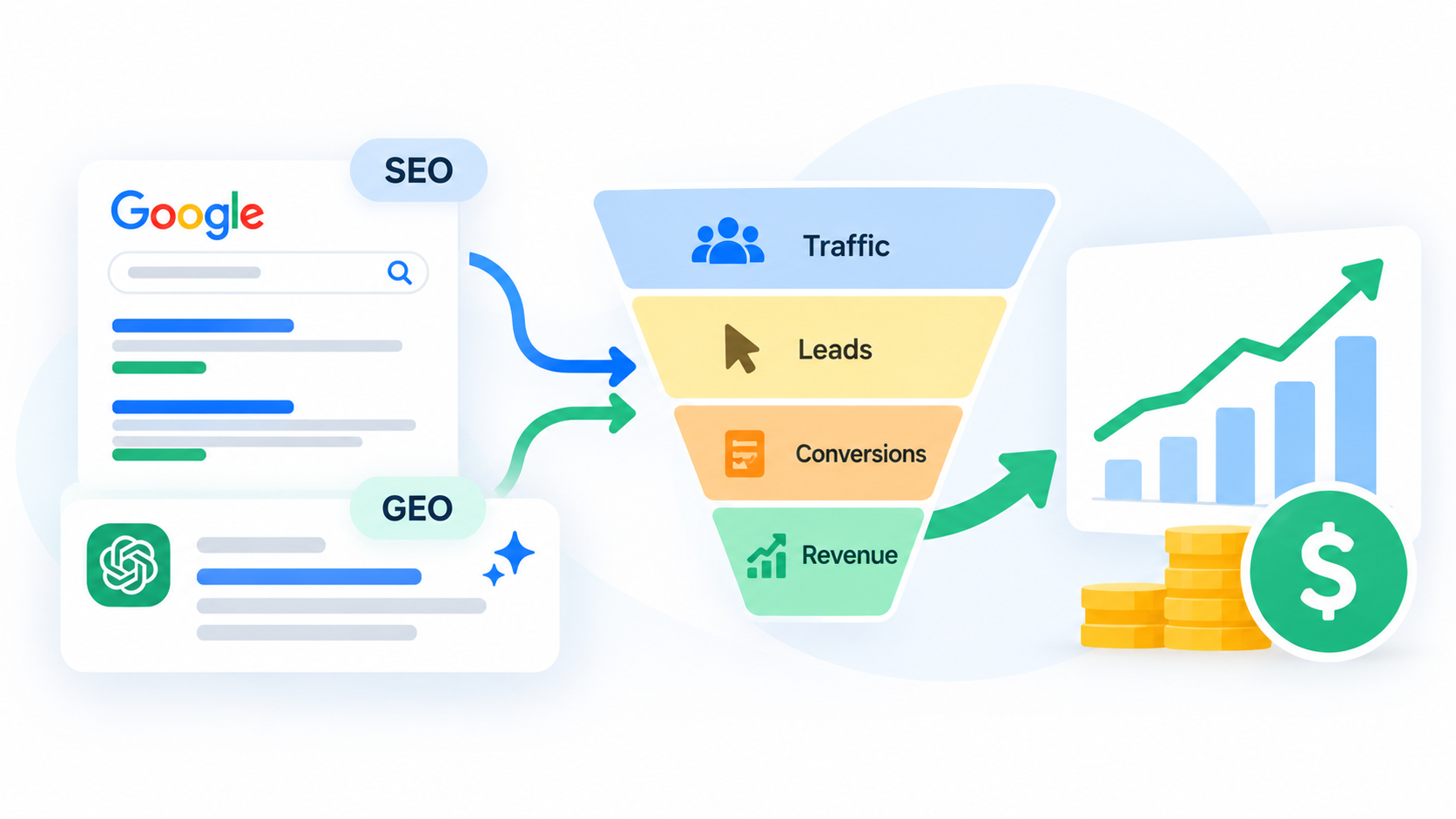
This is why businesses should evaluate SEO and GEO using a combination of visibility, engagement, lead quality, conversion rates, and revenue metrics.
Connect SEO and GEO to the Customer Journey
One of the most useful ways to measure search performance is to connect it with the customer journey.
A typical B2B sales funnel includes several stages:
- Awareness: A potential customer discovers the brand through search results, an AI answer, or educational content.
- Consideration: The visitor explores service pages, comparisons, case studies, and other supporting information.
- Lead generation: The prospect submits a form, requests a quotation, or books a consultation.
- Qualification: The marketing or sales team determines whether the prospect fits the target customer profile.
- Opportunity creation: The qualified lead enters the sales pipeline.
- Conversion: The prospect becomes a paying customer.
Different SEO and GEO activities can influence different stages.
An educational article may introduce a brand to a potential customer. A comparison page may help the same person evaluate providers. A service landing page may encourage them to request a quotation.
AI-generated recommendations can also influence consideration before a visitor reaches the website.
Businesses should therefore define the outcome expected from each page or campaign rather than expecting every piece of content to generate immediate sales.
Measure Conversion Rates Between Funnel Stages
Traffic and impressions show how many people reach a particular stage. Conversion rates help explain how effectively those people progress to the next stage.
For example, consider the following hypothetical B2B performance data:
| Metric | Organic Search | AI Referrals |
|---|---|---|
| Visits | 10,000 | 1,000 |
| Marketing-qualified leads | 200 | 50 |
| MQL conversion rate | 2% | 5% |
| Sales-qualified leads | 40 | 20 |
| SQL conversion rate | 20% | 40% |
In this example, organic search generates more sales-qualified leads overall. AI referrals, however, have higher conversion rates at both qualification stages.
Neither channel should automatically be declared the winner.
To understand commercial value, a business must also consider customer acquisition costs, opportunities created, closed sales, average customer value, and the quality of each channel's traffic.
For example, if both channels convert 25% of their sales-qualified leads into customers, organic search would generate 10 customers while AI referrals would generate five.
If the average customer value were $10,000 for organic search and $30,000 for AI referrals, the resulting revenue would be $100,000 and $150,000 respectively.
These figures are illustrative rather than industry benchmarks. They demonstrate why traffic volume alone can produce an incomplete picture of marketing performance.
Use Lead Qualification and Scoring to Identify Valuable Traffic
Not every conversion represents an equally valuable business opportunity.
A newsletter subscription, a general enquiry, and a request for a detailed service proposal represent different levels of buying intent.
Lead qualification helps businesses distinguish casual interest from genuine commercial potential.
Useful qualification criteria can include:
- Company size and industry
- Geographic location
- Budget and purchasing readiness
- Decision-making authority
- The service or product being considered
- Engagement with high-intent pages
- Requests for demonstrations or quotations
SEO teams can use these insights to identify which pages and search topics attract the strongest prospects.
For example, an educational article may generate 10,000 visits and 300 newsletter subscribers. A specialised integration page may attract only 50 visitors but generate eight booked demonstrations.
If those demonstrations come from qualified prospects, the integration page may deserve additional investment even though it contributes relatively little to overall traffic.
The key is to connect content performance with the quality and progression of the leads it generates.
Connect SEO Performance With Revenue and Customer Economics
Once businesses understand how SEO and GEO influence the sales funnel, they can evaluate performance using commercial metrics.
Important measurements include:
Cost Per Marketing-Qualified Lead
This metric shows how much a business spends to acquire a lead that meets its marketing qualification criteria.
It can help compare content initiatives, organic search programmes, and AI visibility investments when their costs and lead definitions are consistently measured.
Cost Per Sales-Qualified Lead
A sales-qualified lead has progressed beyond initial interest and meets the business's criteria for sales follow-up.
Comparing this metric across channels can reveal which sources generate more sales-ready prospects.
Customer Acquisition Cost
Customer acquisition cost (CAC) measures the cost of acquiring a new customer.
Businesses can use it alongside customer lifetime value (LTV) to evaluate whether their acquisition strategies are economically sustainable.
Pipeline Value and Closed Revenue
Pipeline value estimates the potential value of sales opportunities. Closed revenue represents business that has actually been won.
Both metrics are useful, but they should not be treated as interchangeable. An opportunity in the pipeline is not guaranteed revenue.
Sales Velocity
Sales velocity measures how quickly opportunities move through the pipeline toward a sale.
Content that attracts prospects who make decisions more efficiently may provide additional commercial value, even when its traffic volume is relatively small.
Together, these metrics help businesses prioritise SEO and GEO initiatives according to their potential contribution to growth.
How to Estimate SEO Revenue When Attribution Is Incomplete
Measuring the exact revenue contribution of SEO and GEO can be difficult.
Customers may discover a brand through organic search, return through direct traffic, read an email, and finally convert after speaking with a salesperson. AI-generated recommendations may also influence decisions without producing an immediately identifiable referral.
When direct attribution is unavailable, businesses can use estimates based on historical conversion data.
For example, suppose organic search generates 20 sales-qualified leads. Historical data shows that 20% of these leads typically become customers, and the average customer value is $10,000.
The estimated revenue would be:
20 leads × 20% close rate × $10,000 average customer value = $40,000.
This is expected revenue rather than confirmed revenue. Actual results may differ, so estimates should be compared with subsequent sales outcomes.
Businesses can also monitor directional indicators such as branded search growth, AI citations, qualified website visits, and engagement with high-intent content.
These indicators may suggest that search visibility is influencing demand, but they do not independently prove that a channel generated incremental revenue.
Clear reporting should distinguish confirmed results from estimates and indirect signals.
Build a Better SEO and GEO Reporting Framework
A revenue-focused reporting process does not require businesses to abandon traditional SEO metrics. Rankings, impressions, organic clicks, and AI citations remain useful for understanding visibility.
Instead, these metrics should be connected to business outcomes.
A practical reporting framework should include:
- Visibility: Track rankings, impressions, organic traffic, AI citations, and relevant brand mentions.
- Engagement: Measure meaningful interactions with service pages, comparison content, and conversion-focused assets.
- Lead generation: Track enquiries, form submissions, consultation requests, and other defined conversions.
- Lead quality: Identify which leads meet marketing and sales qualification criteria.
- Sales pipeline: Measure opportunities created and their estimated value.
- Revenue: Report closed customers, actual revenue, and acquisition costs where attribution is reliable.
Teams should agree on definitions, assign ownership, and establish regular review periods.
If a content initiative produces visibility but fails to generate qualified opportunities over time, the team can investigate whether the targeting, content, conversion path, or audience is incorrect.
If another initiative consistently produces valuable opportunities, additional resources may be justified.
This creates a more disciplined approach to SEO investment and makes reporting more useful to business leaders.
Practical SEO and GEO Strategies for Businesses
Businesses looking to connect search performance with revenue can start with a few practical actions.
Prioritise high-intent keywords. Focus on the searches that indicate a genuine need for your product or service, including comparison, pricing, and service-related queries.
Improve conversion-focused landing pages. Make service information clear, explain the value proposition, provide credible evidence, and use relevant calls to action.
Create content for different buying stages. Educational articles build awareness, comparison pages support evaluation, and service pages help convert qualified prospects.
Track lead sources consistently. Use analytics, conversion tracking, and CRM data to understand how prospects enter and progress through the sales funnel.
Monitor AI search visibility in context. Track relevant citations and mentions, but evaluate them alongside qualified visits, enquiries, and measurable commercial outcomes.
Review performance regularly. Reallocate resources when the evidence shows that certain topics or pages generate stronger business results.
These activities help businesses move from reporting marketing activity to understanding marketing contribution.
Final Thoughts
SEO and GEO should not be evaluated solely by how much traffic they generate or how often a brand appears in search results and AI-generated answers.
Their commercial value depends on whether they attract suitable prospects, influence purchasing decisions, create qualified opportunities, and contribute to sustainable revenue.
By borrowing principles from revenue operations, businesses can connect search visibility with funnel progression, lead qualification, customer acquisition costs, and closed sales.
The goal is not to replace traditional SEO metrics. It is to put them into a broader business context.
For marketers, the most useful question is no longer simply how many people discovered a website. It is how effectively that discovery helped the business acquire and retain valuable customers.

About the author
Ayesh Zubair
Founder of Scalviro · Digital Marketer
Ayesh Zubair is the founder of Scalviro, providing SEO, Google Ads and Meta Ads management. He writes about search visibility, paid advertising and digital marketing strategies for businesses.