Google Ads3 Nov 202610 min read
ChatGPT Ads vs Google Search Ads: Which Delivers Better Advertising Results?
A new study reveals that ChatGPT Ads generated 64% less revenue per visit than Google Search Ads. Explore the differences in conversion rates advertising returns and campaign performance and discover what businesses should consider before investing in AI advertising.
By Ayesh Zubair
Artificial intelligence is changing how people discover information, research products, and make purchasing decisions. As AI platforms introduce advertising opportunities, businesses are beginning to explore whether these new channels can deliver the same commercial value as traditional search advertising.
ChatGPT Ads represent a new opportunity for advertisers to reach users while they interact with AI-powered conversations. However, an important question remains: Can advertising on AI platforms generate the same revenue and conversions as Google Search Ads?
A new study published in October 2026 provides some interesting insights.
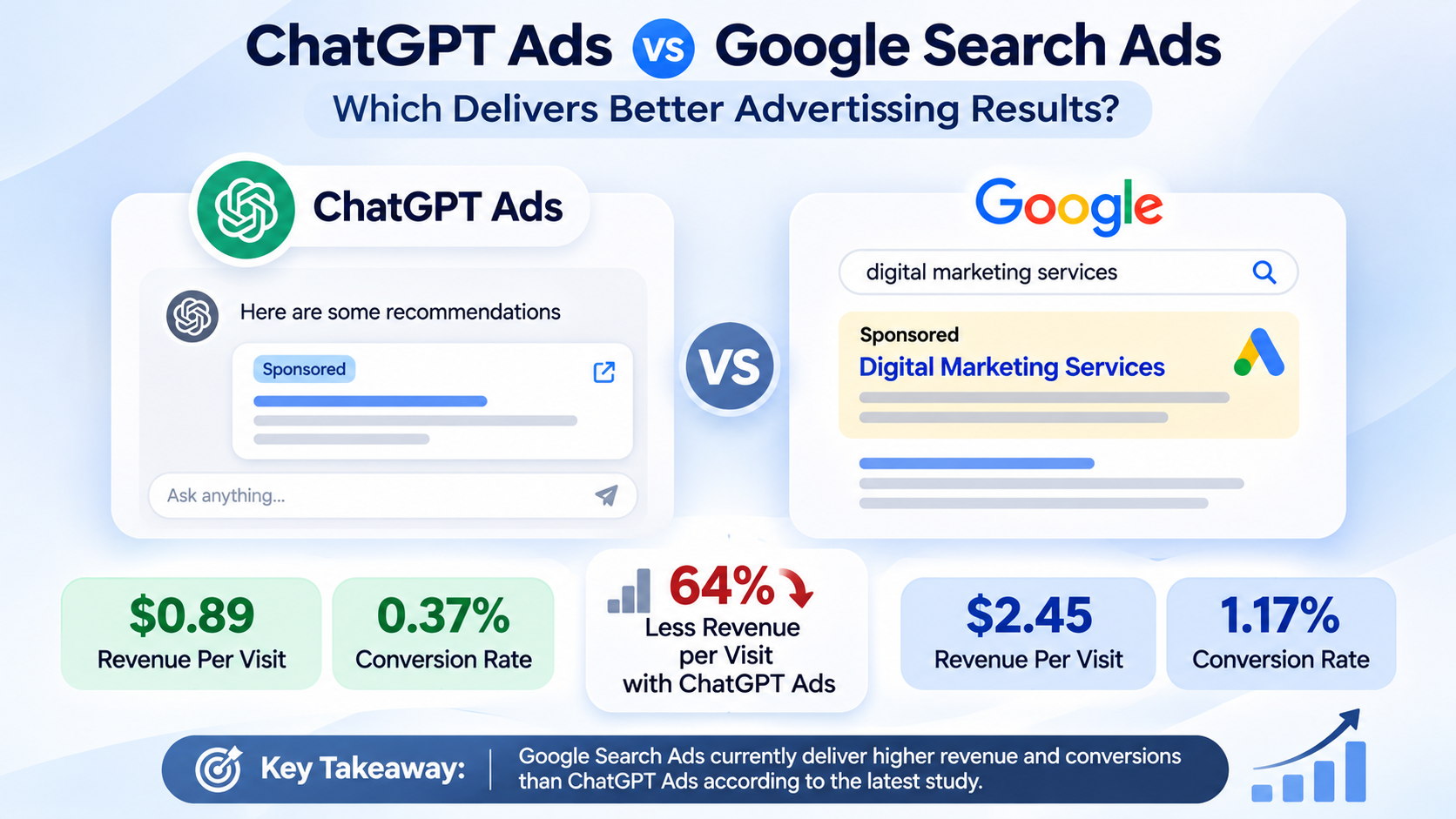
According to research reported by Search Engine Land, ChatGPT Ads generated 64% less revenue per visit than Google Search Ads in U.S. traffic. The findings also revealed significantly lower conversion rates for ChatGPT advertising.
These results highlight why businesses should evaluate new advertising platforms based on actual performance rather than assuming that emerging technology automatically delivers better marketing results.
In this article, we explore the study, compare ChatGPT Ads with Google Search Ads, and explain what advertisers should consider when allocating their marketing budgets.
What Does the New Study Reveal About ChatGPT Ads?
The study was conducted by researchers Maximilian Kaiser and Christian Schulze and examined advertising performance across a large collection of websites.
The research analyzed nearly 10 billion sessions across 1,898 websites between June 2025 and August 2026. The paid advertising comparison used a smaller group of advertiser websites with relevant sales tracking data.
The findings showed that paid ChatGPT visits generated considerably less revenue per session than paid Google Search visits.
Key findings included:
- ChatGPT Ads generated $0.89 in revenue per session.
- Google Search Ads generated $2.45 in revenue per session.
- ChatGPT Ads had a conversion rate of 0.37%.
- Google Search Ads had a conversion rate of 1.17%.
- Among 87 advertisers using both channels, 97% generated less revenue per ChatGPT visit.
These figures are based on the U.S. traffic comparison reported in the study. They should not automatically be treated as benchmarks for every industry, advertiser, or campaign type.
The results nevertheless suggest that Google Search Ads currently deliver stronger direct revenue performance in the dataset analyzed.
ChatGPT Ads vs Google Search Ads: Revenue Comparison
One of the most important findings is the difference in revenue generated by visitors from each advertising channel.
| Performance Metric | ChatGPT Ads | Google Search Ads |
|---|---|---|
| Revenue Per Visit | $0.89 | $2.45 |
| Conversion Rate | 0.37% | 1.17% |
| Relative Revenue | Lower | Higher |
Google Search Ads generated approximately 2.75 times more revenue per visit than ChatGPT Ads in the study.
This difference matters because advertisers do not simply pay for website visits. They invest in advertising to generate purchases, leads, and measurable business outcomes.
A channel that attracts visitors but generates fewer conversions may struggle to deliver a competitive return on advertising spend.
For businesses working with limited budgets, this makes channel-level performance measurement particularly important.
Why Are Google Search Ads Generating More Revenue?
There are several factors that may help explain the performance difference between the two platforms.
1. Stronger Purchasing Intent
Google Search users often actively search for specific products, services, and solutions.
For example, someone searching for "buy office furniture online" may already be considering a purchase.
Similarly, someone searching for "Google Ads management services" may be looking for a provider and comparing available options.
This type of search activity can indicate strong commercial intent.
ChatGPT users may have different objectives. They might be researching a topic, asking general questions, comparing options, or looking for recommendations.
Although these interactions can influence purchasing decisions, not every conversation represents immediate buying intent.
2. Different User Behaviour
Google Search is designed around helping users find relevant information and websites through search queries.
ChatGPT provides conversational answers and allows users to explore topics through follow-up questions.
These different experiences can influence how people interact with advertisements and whether they decide to visit an advertiser's website.
A visitor arriving through a high-intent Google search may be further along in the purchasing journey than someone discovering a product through an AI conversation.
3. Established Search Advertising Ecosystem
Google Ads has a mature advertising ecosystem supported by years of campaign data, keyword targeting, conversion measurement, automated bidding, and optimization tools.
Advertisers can use different campaign types and bidding strategies to reach customers based on their business objectives.
ChatGPT advertising is a newer opportunity. Advertisers and platforms are still learning how to measure performance, understand user behaviour, and improve campaign effectiveness.
As AI advertising develops, its performance and available optimization capabilities may change.
What Is the Conversion Rate Difference?
Conversion rate is one of the most important advertising metrics because it measures how effectively website visitors complete a desired action.
According to the study:
- ChatGPT Ads converted at 0.37%.
- Google Search Ads converted at 1.17%.
This means Google Search Ads achieved more than three times the conversion rate of ChatGPT Ads in the reported comparison.
For example, consider a hypothetical campaign receiving 10,000 website visits.
At a 0.37% conversion rate, ChatGPT Ads would generate approximately 37 conversions.
At a 1.17% conversion rate, Google Search Ads would generate approximately 117 conversions.
This is an illustrative calculation using the study's reported conversion rates, not a guarantee of future campaign performance.
The difference demonstrates why advertisers should evaluate conversion rates alongside traffic volume and advertising costs.
How Much Should Advertisers Pay for ChatGPT Ads?
Another interesting part of the research is the estimated click price required for ChatGPT Ads to deliver a return comparable to Google Search Ads.
The researchers estimated that a ChatGPT ad click would need to cost approximately $0.26 to achieve a similar return under their comparison assumptions.
One publicly disclosed advertiser reportedly paid $1.72 per click.
This illustrates the importance of understanding the relationship between advertising costs and revenue generated.
However, the $0.26 figure is a research-based parity estimate, not an official ChatGPT advertising price or a universal recommended bid.
Actual click values depend on several factors, including:
- Average order value
- Conversion rate
- Profit margins
- Customer lifetime value
- Cost per click
- Lead quality
- Attribution methods
Advertisers should calculate their own acceptable cost per click using their campaign data rather than relying on a single industry-wide estimate.
Does ChatGPT Advertising Affect Organic AI Traffic?
The study also examined whether introducing advertisements affected unpaid referrals from ChatGPT.
Researchers estimated that organic ChatGPT referrals declined by approximately 5.9% during the first 13 weeks following advertising launches.
After adjusting for assumed differences in regional adoption growth, the estimated decline increased to approximately 7.2% to 8.4%.
However, this finding requires careful interpretation.
The initial estimate was not statistically significant. The adjusted estimates were statistically significant under the researchers' assumptions.
The study also found no detectable change in the conversion rate of organic ChatGPT visitors.
This suggests that the introduction of advertising may influence referral volume, but the available findings do not establish that advertisements necessarily reduce the commercial value of every organic AI referral.
For businesses investing in AI search visibility, monitoring both referral traffic and conversions remains important.
Should Businesses Shift Their Advertising Budgets From Google to ChatGPT?
The current findings do not support moving advertising budgets away from Google Search simply because AI advertising is becoming popular.
However, they also do not mean advertisers should completely ignore emerging AI advertising platforms.
The right decision depends on campaign objectives, audience behaviour, costs, and measurable results.
When Google Search Ads May Be the Better Choice
Google Search Ads may be a stronger starting point when:
- Your customers actively search for your products or services.
- You need leads or sales with clear commercial intent.
- You have a limited advertising budget.
- You want detailed keyword and search-term insights.
- You need established conversion tracking and bidding options.
- Your business depends on capturing existing search demand.
When ChatGPT Ads May Be Worth Testing
ChatGPT advertising may be worth evaluating when:
- Your target audience actively uses AI assistants.
- Your products or services benefit from conversational discovery.
- You want to explore an additional advertising channel.
- You have sufficient budget for controlled experimentation.
- You can measure leads, sales, and revenue accurately.
- Your campaign objectives extend beyond immediate purchases.
Rather than making a complete budget shift, advertisers can evaluate ChatGPT Ads through a controlled test while maintaining their established campaigns.
How to Measure ChatGPT Ads and Google Ads Performance
Businesses should compare advertising platforms using consistent measurement methods.
Looking only at impressions, clicks, or cost per click can produce misleading conclusions.
Consider tracking the following metrics:
Cost Per Click (CPC)
Measures how much you pay for each advertising click.
A lower CPC can be beneficial, but it does not guarantee profitable advertising.
Conversion Rate
Measures the percentage of visitors who complete a desired action.
This can include purchases, qualified lead submissions, registrations, or appointment bookings.
Cost Per Acquisition (CPA)
Measures the average advertising cost required to acquire a customer or generate a defined conversion.
Revenue Per Visit
Shows how much revenue is generated on average by visitors from a particular advertising channel.
This metric helps compare the commercial value of website traffic.
Return on Ad Spend (ROAS)
ROAS measures the revenue attributed to advertising relative to advertising expenditure.
For example, if a business spends $1,000 and generates $4,000 in attributed revenue, its ROAS is 4x.
However, revenue alone does not account for product costs, operating expenses, or profit margins.
Customer Acquisition Cost (CAC)
CAC measures the overall cost of acquiring a new customer.
Businesses should consider it alongside customer lifetime value to understand long-term profitability.
Practical Recommendations for Digital Marketers
The study provides several useful lessons for advertisers and marketing professionals.
1. Prioritize High-Intent Search Campaigns
If your customers actively search for your products or services, Google Search Ads can be a strong channel for capturing existing demand.
2. Focus on Conversion Quality
Do not evaluate campaigns only by traffic volume or cheap clicks. Measure qualified leads, completed purchases, and revenue.
3. Use Accurate Conversion Tracking
Make sure advertising platforms are receiving reliable conversion data. Incorrect tracking can lead to misleading performance comparisons.
4. Test New Advertising Channels Carefully
Emerging platforms can offer new opportunities, but advertisers should start with controlled experiments and clear performance targets.
5. Evaluate Profitability Rather Than Popularity
A platform should earn a larger share of your budget because it delivers business value, not simply because it is receiving attention.
6. Review Attribution Limitations
Last-click attribution and website session revenue may not capture every influence on a customer's purchasing decision. Consider assisted conversions and longer customer journeys when evaluating performance.
Final Thoughts
The latest research highlights an important difference between emerging AI advertising and established search advertising.
ChatGPT Ads generated 64% less revenue per visit than Google Search Ads in the U.S. comparison, while their conversion rate was also considerably lower.
These findings suggest that Google Search remains a stronger direct-response advertising channel in the dataset analyzed.
However, AI advertising is still developing, and its long-term potential should not be judged entirely by early performance figures.
For businesses and digital marketers, the smartest approach is to focus on measurable results. Continue investing in channels that generate profitable conversions, test emerging platforms carefully, and make advertising decisions based on actual campaign performance.
The goal of digital advertising is not simply to generate more clicks. It is to turn the right visitors into valuable customers.

About the author
Ayesh Zubair
Founder of Scalviro · Digital Marketer
Ayesh Zubair is the founder of Scalviro, providing SEO, Google Ads and Meta Ads management. He writes about search visibility, paid advertising and digital marketing strategies for businesses.