Google Ads22 Oct 20269 min read
Should Your PPC Landing Pages Change for Google AI Overviews?
Learn how Google AI Overviews are changing paid search and discover how to optimize PPC landing pages for search intent ad relevance and better conversions.
By Ayesh Zubair
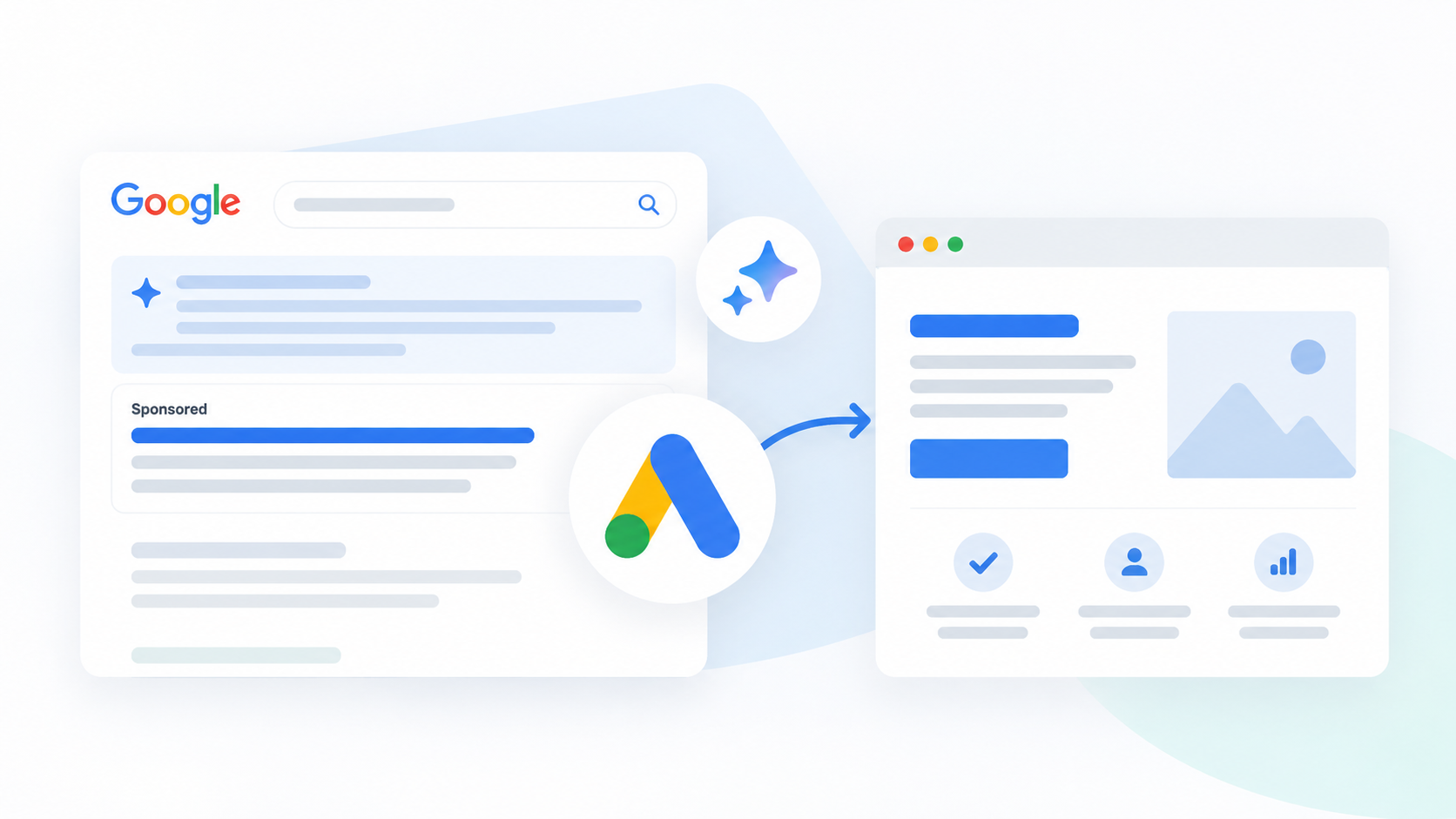
Google AI Overviews are changing how users discover information and interact with search results. For Google Ads advertisers, this shift raises an important question: Do PPC landing pages need to be redesigned to perform well in AI-powered search?
The answer is not to rebuild every landing page or add unnecessary content. Instead, advertisers should focus on search intent, message relevance and the user experience after an ad click.
According to Search Engine Land, Google's AI-powered search experiences make it increasingly important for landing pages to communicate an offer clearly and deliver on the promise made in the ad.
How Google AI Overviews Are Changing the PPC Journey
Traditional paid search often begins when someone enters a query, reviews the available results and clicks an advertisement.
With AI-powered search, users may first explore a question through an AI-generated overview before deciding which option to visit. Search and Shopping ads can also appear within AI-powered search experiences.
This creates a more context-driven journey:
Search query → AI-assisted exploration → Ad click → Landing page → Conversion
For advertisers, the main challenge is ensuring that the landing page remains relevant to the user's needs, even when the search query is longer or more conversational than a traditional keyword.
A person searching for a marketing service may want pricing information, proof of results or a comparison of available providers. A landing page that immediately addresses these needs can provide a more useful experience.
Do PPC Landing Pages Need Special Optimization for AI Overviews?
Not necessarily.
Advertisers do not need to create separate landing pages exclusively for AI Overviews or fill existing pages with AI-related keywords.
Google's established principles around helpful content, relevance and usability remain important. For paid campaigns, the landing page must also support the specific objective of the advertisement.
Instead of making changes simply because AI Overviews exist, review whether your current pages answer the questions potential customers have before converting.
The most useful improvements often involve clearer messaging, stronger alignment between ads and landing pages, accessible information and a straightforward conversion process.
1. Make Your Offer Clear Within Seconds
When visitors arrive on a landing page, they should quickly understand what you offer and whether it meets their needs.
A vague headline or an unclear value proposition can make users hesitate, even if the advertisement successfully attracts the right audience.
Your landing page should clearly communicate:
- The offer: Explain the product or service you provide.
- The target audience: Identify who benefits from the offer.
- The main benefits: Describe the practical value customers receive.
- Your differentiators: Explain what makes your solution relevant.
- The next step: Make it easy to enquire, book a call, purchase or request a quote.
For example, a digital marketing landing page should clearly state which services are available, which businesses they serve and how prospective clients can get started.
Avoid hiding essential details behind generic headlines or large decorative elements. Clear communication helps both visitors and Google's systems understand the page.
2. Optimize for Search Intent Instead of Individual Keywords
Different search queries can express the same underlying need.
For example, a user looking for PPC management might search for:
- Google Ads management services
- PPC agency for small businesses
- Help improving Google Ads conversions
- Affordable paid search management
Although these searches use different wording, they may indicate a similar need: finding professional help with paid advertising.
Creating a separate landing page for every minor keyword variation is not always necessary. Instead, organize your pages around meaningful differences in services, audiences and user intent.
A single well-developed landing page may serve several closely related queries if it addresses their shared needs effectively.
However, distinct services or audiences may still require separate pages when their offers and conversion requirements differ significantly.
3. Avoid Adding Content That Does Not Help Visitors Convert
A longer landing page is not automatically a better landing page.
While detailed information can help users evaluate complex or expensive services, unnecessary content may distract visitors from the main offer.
Focus on providing the information needed to make a decision.
Depending on the business, this may include:
- Service features and benefits
- Pricing or an explanation of how quotes work
- Relevant case studies or testimonials
- Frequently asked questions
- Delivery timelines or eligibility requirements
- Clear calls to action
For example, a landing page promoting a free consultation may not need a lengthy educational guide. It needs a clear explanation of the consultation, the benefits of booking and a simple form.
The goal is to provide enough information to build confidence without overwhelming potential customers.
4. Keep Your Ad Copy and Landing Page Consistent
One of the most important PPC landing page principles is message alignment.
If an advertisement promises a particular service, price, discount or result, the destination page should support that promise.
Consider an ad promoting affordable Google Ads management for small businesses. If the landing page focuses on enterprise-level marketing solutions without explaining whether small businesses are served, visitors may feel that the offer does not match their expectations.
This can create a poor user experience and reduce the likelihood of conversion.
A useful way to review message alignment is to follow the complete customer journey:
Search intent → Ad headline → Landing page headline → Offer details → Call to action
Each step should reinforce the same core message.
This is particularly important as Google's advertising systems use landing page content and other signals to help match advertisements with relevant searches.
5. Prepare Your Website for Automated Landing Page Selection
Google Ads automation can use landing page content to help identify relevant destinations for different searches.
Features such as AI Max for Search and Final URL expansion can give Google more flexibility in matching users with pages on a website.
This means advertisers should evaluate their website beyond the specific landing pages they have manually selected for campaigns.
Ask yourself:
- Are all important service pages accurate and up to date?
- Does each page clearly explain its offer?
- Are irrelevant or outdated pages accessible to advertising systems?
- Do your pages support the expectations created by your ads?
- Would a visitor arriving on a different relevant page still have a clear path to conversion?
Review your campaign settings before enabling automated URL selection. Where appropriate, use URL exclusions and other available controls to prevent traffic from reaching unsuitable destinations.
Automation can help identify relevant pages, but it does not remove the need for careful website structure and landing page quality.
6. Make Important Information Easy to Understand
Landing page content should be accessible to both people and search systems.
Use descriptive page titles, clear headings, concise paragraphs and meaningful section labels. Present essential details as readable text rather than placing all important information inside images.
For example, a service page should explain its core offering in text instead of relying entirely on a promotional graphic.
Use structured data where it is appropriate for the content and supported by Google's guidelines. However, do not assume that adding schema markup will guarantee placement in AI Overviews or improve paid ad performance directly.
The priority is to make your website understandable, useful and easy to navigate.
7. Improve the Conversion Experience
A relevant advertisement can attract a potential customer, but the landing page must make the next step easy.
Review your pages for common conversion barriers, including:
- Forms that request unnecessary information
- Slow-loading pages
- Poor mobile layouts
- Unclear calls to action
- Missing trust signals
- Confusing navigation
- Unexpected costs or conditions
Choose calls to action that match the offer and the customer's stage of consideration.
For example, a high-intent service page might use a prominent “Request a Quote” button, while an informational offer may benefit from “Download the Guide.”
Track meaningful actions such as qualified leads, completed purchases and booked consultations rather than judging landing pages solely by clicks.
PPC Landing Page Audit Checklist
Before rebuilding your landing pages for Google AI Overviews, use this checklist to identify practical improvements.
Clarity
- Is the offer immediately understandable?
- Is the target audience clearly identified?
- Are the main benefits and differentiators visible?
Search intent
- Does the page address the user's underlying need?
- Can it serve closely related search queries effectively?
- Does the content match the intent behind the advertisement?
Ad relevance
- Does the headline support the ad's promise?
- Are pricing, features and conditions consistent?
- Is the next step clear?
User experience
- Does the page work well on mobile devices?
- Is the content easy to scan?
- Can visitors complete the intended action without unnecessary friction?
Conversion tracking
- Are important conversions tracked correctly?
- Are duplicate or accidental conversions being avoided?
- Can you compare landing page performance using qualified leads or sales?
Automation readiness
- Would the page be suitable if Google's systems selected it automatically?
- Are outdated or irrelevant URLs excluded where necessary?
- Does the wider website provide useful destinations for different search intents?
Final Thoughts
Google AI Overviews are changing how people explore search results, but they do not eliminate the fundamentals of effective PPC landing pages.
Advertisers do not need to redesign every page or create separate versions specifically for AI-powered search. They should focus on what matters most: understanding search intent, communicating the offer clearly, matching the advertisement's promise and making conversion easy.
Start by auditing your existing pages and identifying the issues that could prevent a qualified visitor from taking action. Test improvements using actual campaign performance and conversion data.
Ultimately, a strong PPC landing page should help the right customer understand the offer and confidently take the next step, regardless of how they discovered the advertisement.